
Rounded Worktop Corners for Toddler-Height Heads
Square worktop corners sit right at toddler head height on islands and peninsulas, so a radiused corner and softened arris are simple safety details worth specifying.
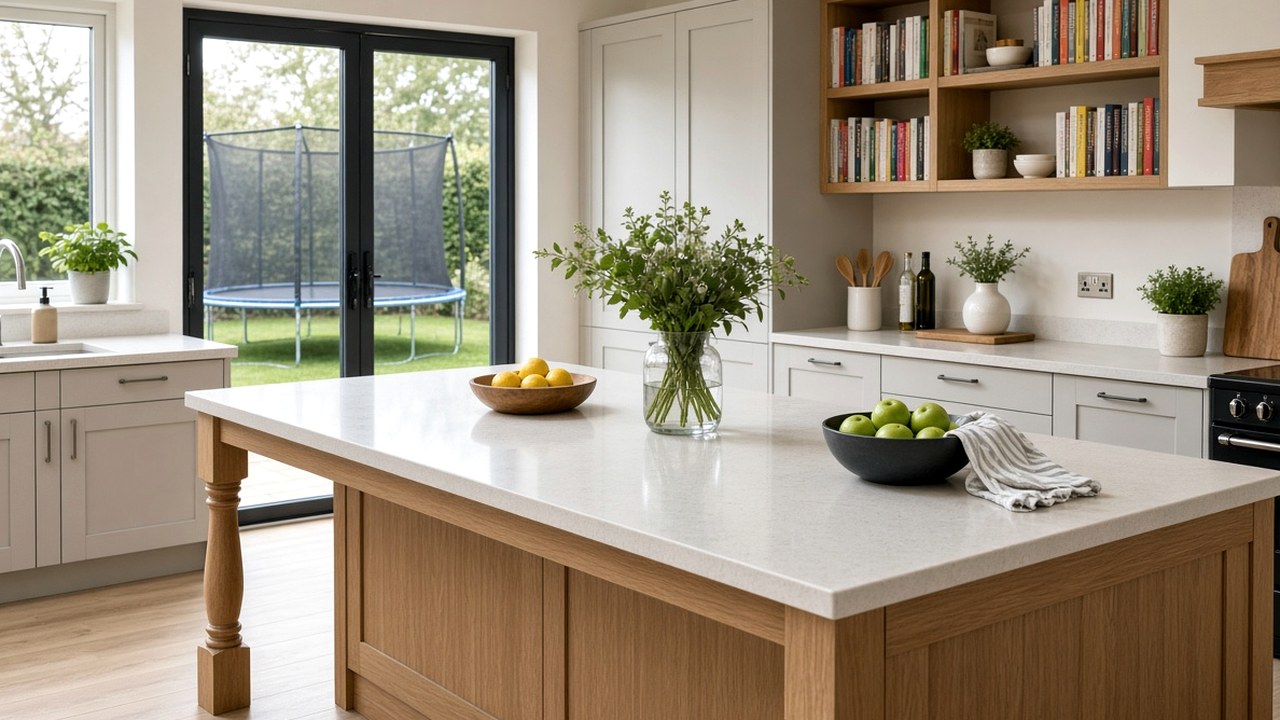
Every parent of a toddler learns quickly where the kitchen's sharp corners are, usually at exactly the height of a small forehead. Island and peninsula ends are the worst culprits, because children run around them. Rounding those corners costs little at fabrication and removes a daily worry. Kitchen Worktops Plus suggests radiused corners on most family islands, and explains how to choose the right detail.
Find the corners that matter
Not every corner needs rounding. Corners against walls or tall units are rarely a problem. The ones to worry about are exposed corners at walkways: island ends, peninsula ends, breakfast bar corners and the end of a run next to a doorway. Walk around your kitchen plan and mark every exposed corner that a child might run past.
Kitchen Worktops Plus explains peninsula sizing in size the peninsula for homework, school bags and real stools.
- Island and peninsula ends are the main risks.
- Corners at doorways and walkways matter most.
- Corners against walls rarely need rounding.
Choose a corner radius
A radius describes how rounded the corner is when viewed from above. A small radius slightly softens the point; a larger radius creates a noticeably curved corner. For family safety, a moderate radius is a sensible choice, and larger radii suit contemporary kitchens. Solid surface can be shaped to almost any radius.
Ask your fabricator to show you samples or drawings of different radii. The right radius balances safety and appearance.
Soften the edge profile too
The corner radius is seen from above; the edge profile is seen from the side. A square edge with a sharp arris can still hurt even on a rounded corner. A softened arris or a gently rounded edge profile reduces the risk further.
Solid surface is well suited to softened profiles because it can be shaped and sanded smoothly.
- Radius the corner from above.
- Soften the arris on the edge profile.
- Solid surface shapes smoothly.
Consider the whole island shape
Some families choose islands with fully curved ends, which look softer and remove corners completely. Curved ends also improve circulation, because people and children flow around them more easily. Kitchen Worktops Plus explains family specification in specify a family worktop for Wednesday, not for a staged Saturday.
Plan it at the template stage
Corner radii are cut during fabrication, so they must be specified before the template is finalised. Tell the templater which corners you want rounded and the radius you prefer. Changing corners after fabrication is difficult.
Add temporary protection if needed
Even with rounded corners, some parents add soft corner guards while children are very young. Choose guards that do not leave adhesive marks on the worktop. Remove them when children are older.
Kitchen Worktops Plus describes radiator and corner planning in tell the templater about radiators, coat rails and occupied corners.
Radius options compared in plain terms
Fabricators often describe corners by the radius measurement, which is not easy to picture. A practical way to compare them is to ask for a printed full-size drawing of each option, or to trace the corner of a dinner plate, a saucer and a coin onto cardboard and hold them at the island end. A coin-sized curve softens the point; a saucer-sized curve is noticeably rounded; a plate-sized curve makes the corner a design feature.
In a family kitchen, the middle option is often the sweet spot. It removes the sharp point that causes most bumps while still looking crisp and contemporary. A very large curve works well on a freestanding island, but it can look odd on a peninsula that meets a square wall.
- Coin-sized curves soften the point.
- Saucer-sized curves are clearly rounded.
- Plate-sized curves become a design feature.
Material makes a difference
Solid surface is well suited to rounded corners because the fabricator can shape and sand the corner to a consistent radius, and the edge profile can follow the curve smoothly. Chips on a rounded corner can usually be repaired. Stone and quartz can be radiused too, although larger curves take more workshop time. Laminate worktops generally come with square or post-formed edges, so ask about corner options before choosing a laminate for an island.
Overhangs, stools and bumped knees
Rounded corners are only part of the story. An overhanging breakfast bar is at a similar height to a child's head when they are standing, and at knee height for adults sitting on stools. Keep overhangs to a sensible depth, and check that the corner of the overhang is radiused too, not just the corner above the cabinets.
Brackets and supports under an overhang should be positioned where children are unlikely to run into them. Concealed steel supports or a solid end panel are safer than exposed metal legs close to a walkway.
- Radius the overhang corner, not just the cabinet corner.
- Keep overhang depth sensible.
- Position supports away from walkways.
Looking ahead as children grow
Rounded corners stay useful long after the toddler years. Teenagers still rush past the island, and adults carrying shopping bags or laundry baskets appreciate softer edges too. Because they are part of the fabricated worktop, they do not need replacing like temporary guards. For a wider look at family-friendly layout, see building a drop zone for keys, post and chargers into the worktop plan.
Questions about rounded worktop corners
Do rounded corners cost more?
A radius is usually a small addition at fabrication. Ask your fabricator for the price.
Which corners should be rounded in a family kitchen?
Exposed island, peninsula and breakfast bar corners at walkways are the priority.
Can existing worktop corners be rounded?
With solid surface, it may be possible on site. Ask a fabricator to assess it.
What radius should I choose for a family island?
A moderate curve, roughly the size of a saucer's edge, removes the sharp point while still looking crisp. Ask for full-size drawings to compare.
Can laminate worktops have rounded corners?
Options are more limited. Ask the supplier before choosing laminate for an island with exposed corners.
Should breakfast bar overhangs have rounded corners too?
Yes. Overhang corners sit at head height for small children, so radius them as well.
Next step with Kitchen Worktops Plus
Order a sample, then request a fitted quote or browse the worktop collection. The colour should be judged in your own daylight before anyone templates the run.