
How to Clean and Care for Hanex Worktops
Hanex is non-porous and easy to keep clean. This guide covers everyday cleaning, stains, chemicals to avoid and how to deal with scratches.

If children eat at the island, skip the high-contrast dark matt that shows every fingerprint and choose a forgiving pale instead. Kitchen Worktops Plus is written for family kitchens — homework at the peninsula, a farmhouse sink, and a surface that should still look decent on a Monday morning.
Hanex worktops are easy to look after. The manufacturer describes Hanex as non-porous and solid through the entire material, so everyday spills sit on the surface rather than soaking in, and there is no sealing or oiling to do. A damp cloth handles most daily cleaning. Beyond that, the key is to avoid a few harsh chemicals, protect the surface from heat and knives, and know what to do if it gets marked.
This guide brings together the manufacturer’s care advice with practical tips for looking after Hanex worktops in a busy UK kitchen.
Everyday cleaning
Hanex’s care guidance is simple: wipe clean with a damp cloth or sponge. For most kitchens that means:
- A soft cloth or sponge and warm water
- A little washing-up liquid or a general all-purpose cleaner for greasy marks
- A dry cloth to finish, to prevent water marks and limescale
Wipe down after cooking, paying attention to the areas around the hob, sink and kettle, where splashes and drips build up fastest.
Do not forget matching upstands and splashbacks. Grease and steam from cooking settle on vertical surfaces too, and a splashback behind the hob benefits from a quick wipe every time you cook. Cleaning them with the same cloth and detergent keeps the whole surface looking consistent.
Keeping the finish even
Here are the kitchen worktop ranges we currently supply:
Over time, the areas you use most can start to look slightly different from the rest of the worktop. Hanex’s care guidance suggests periodically going over the entire surface with a mild abrasive cleanser to maintain a uniform appearance. Work over the whole worktop, not just one patch, and rinse thoroughly afterwards.
If your worktop has a high-gloss finish, check with us before using any abrasive product, as glossier finishes generally need gentler care.

Removing stains
Everyday stains
Most marks from tea, coffee, wine, fruit and cooking oils lift with mild detergent or a general all-purpose cleaner. Wipe them up as soon as you can, before they dry.
Stubborn stains
For persistent stains, Hanex’s care guidance suggests scrubbing the area with a mild abrasive cleanser and a non-scratch scouring pad. Work gently in small circles, then rinse and dry. As above, take extra care on glossier finishes.
Limescale
In hard water areas, limescale can collect around taps. Wiping and drying the area every day is the best prevention.
Chemicals to avoid
Hanex’s care guidance advises avoiding strong chemicals that can damage the surface, including:
- Oven cleaners
- Acetone, including some nail varnish removers
- Paint removers
If any of these come into contact with the worktop, flush the area with plenty of water straight away. Strong acids, such as those found in drain cleaners, should also be flushed away with water immediately. Keep these products away from the worktop when you use them elsewhere in the kitchen.
Protecting Hanex from heat
The manufacturer is clear: never place hot pans directly on the worktop, and always use trivets with rubber feet when putting hot items down. Prolonged or extreme heat can cause permanent damage.
- Keep trivets beside the hob and oven.
- Stand slow cookers, air fryers and grills on a heat-resistant board.
- Do not slide pans off the hob onto the worktop beside it.
Chopping and food preparation
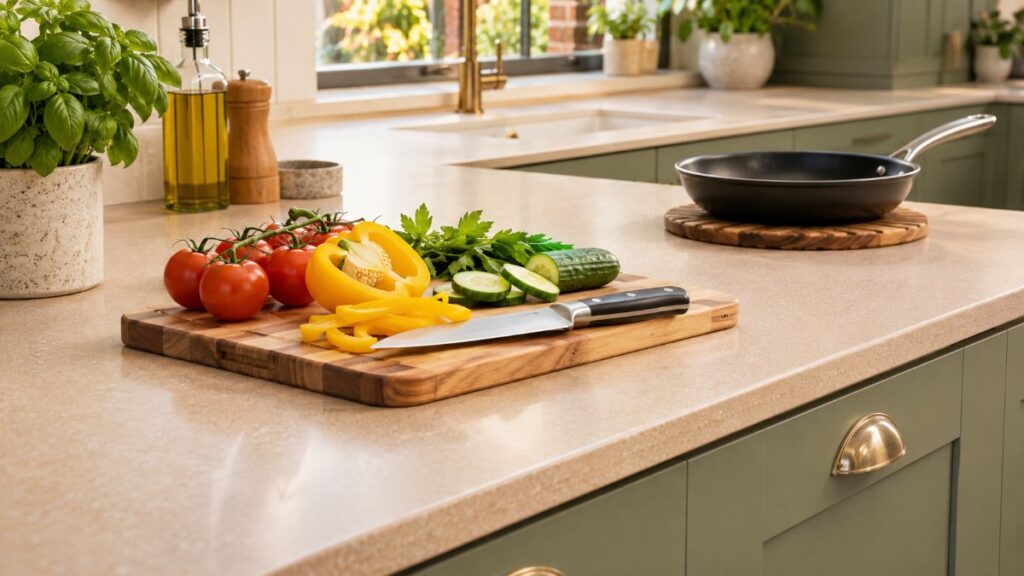
Avoid cutting directly on Hanex and always use a chopping board. Knives will leave scratches, and cutting on any hard surface quickly blunts them. The smooth, non-porous surface is ideal for rolling pastry and preparing food on, as long as the knife work happens on a board.
Scratches and minor damage
Because Hanex is solid through the material, it can usually be repaired. Light surface marks can often be improved with the mild abrasive cleaning described above. Deeper scratches, chips, heat marks and other damage should be left to a professional, as the manufacturer recommends.
Our repair and repolish service can help. A professional repolish sands and polishes the whole surface back to an even finish and removes most scratches. Chips and deeper scratches can be filled, levelled and blended in. Send us a few photos, including one of the whole worktop and close-ups with a coin for scale, for a free, no-obligation quote.
Integrated sinks
If you have an integrated solid surface sink, clean it in the same way as the worktop. Wipe it out after use and dry it to prevent limescale. Hanex’s heat advice applies here too: let hot pans cool before they go into the sink.
Common care mistakes to avoid
- Cleaning one spot over and over. Scrubbing a single patch can leave it looking different. Clean the whole area evenly.
- Leaving cleaner to dry. Always rinse away detergent and dry the surface to avoid smears.
- Using the worktop as a pan stand. Even a brief contact with a very hot pan can leave a mark.
- Dragging heavy items. Lift pans, mixers and stoneware rather than sliding them across the surface.
- Trying DIY repairs on deep damage. Leave chips, deep scratches and cracks to a professional.
A quick Hanex care checklist
- Daily: damp cloth, mild detergent, dry.
- Weekly: a thorough clean of the whole worktop, upstands and splashbacks.
- Occasionally: a mild abrasive cleanser over the whole surface to keep the finish even, unless it is high gloss.
- Always: chopping boards, trivets, and no oven cleaner, acetone or paint remover.
Choose Hanex with confidence
With a little everyday care, Hanex stays a practical, good-looking worktop for years, and it can usually be repolished if it starts to look tired. Browse the colours on our Hanex worktops page, order a free sample, and request a quote for supply and fit anywhere in the UK.